Conveners
Plenary session
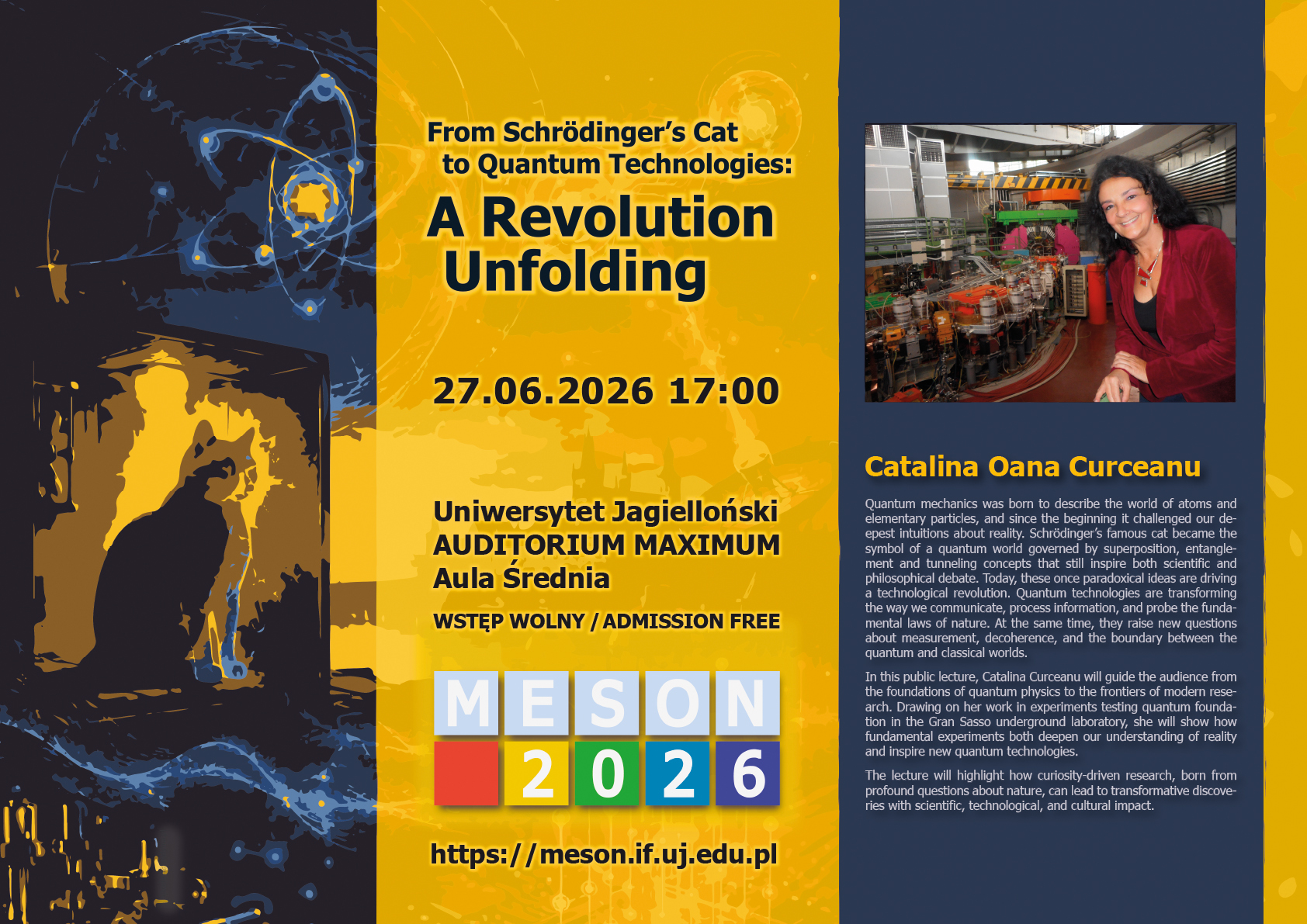
- Catalina Oana Curceanu (INFN-LNF)
Plenary session
- Antoni Szczurek (Institute of Nuclear Physics PAS)
Plenary session
- James Ritman (GSI, Jülich, RU Bochum)
Plenary session
- Joachim Stroth (Goethe University)
Plenary session
- Patrizia Rossi (Jefferson Lab)
Plenary session
- Piotr Salabura (Jagiellonian University)
Plenary session
- Frank Nerling (GU Frankfurt & GSI Darmstadt)
Plenary session
- Andrzej Kupsc (Uppsala University)
Plenary session
- Avraham Gal (Hebrew University)
Observation of a family of all-charm tetraquarks with spin-2 and positive parity
Three structures, denoted as X(6600), X(6900), and X(7100), have been observed in the J/\psi J/\psi mass spectrum and are interpreted as candidates for a family of fully-charm tetraquark states. Using proton-proton collision data collected by the CMS detector corresponding to an integrated luminosity of 315...
Interest in photoproduction processes involving open- and hidden-charm final states has considerably grown in the last few years, both experimentally and theoretically. This is primarily because of two active research ares: the possibility of exploring exotic hadron candidates in the charm sector in novel production modes and the possible extraction of the gravitational properties of the...
The LHCb experiment has delivered groundbreaking results in hadron spectroscopy and exotic state studies, enabled by its large collision dataset. This contribution summarizes the latest discoveries and precision measurements of conventional and exotic hadrons at LHCb, discusses their implications for quantum chromodynamics, and outlines future prospects for hadron physics research at the LHC.
What are the mechanisms behind the labyrinthine spectrum of excited hadrons? This question challenges our understanding of strong interaction and is of relevance to many applications where the exact parameters of these states influence interaction patterns.
In turn, many open questions in this regard hinge on a precise understanding of the multi-hadron dynamics. In the last decade a large...
Since the turn of the century it becomes evident that the naive quark model is not capable to describe the rich phenomenology of hadrons, especially in the doubly heavy sector. For a large number of those states a molecular structure, where the states are understood as analogs to atomic nuclei, appears to be a natural description. In this talk I review the theory of hadronic molecules, how...
I will discuss the latest developments in Regge theory, including its applications to the analysis of hadron spectroscopy data, with a focus on exotica.
Since its operation began in 2008, the BESIII experiment has accumulated an integrated luminosity of 50 fb⁻¹ in the center-of-mass energy range of 1.84-4.95 GeV. Using these data samples, BESIII has achieved a large number of significant results in areas such as light hadron spectroscopy, charmonium physics, hyperon physics, and the physics of charmed mesons and charmed baryons, providing...
FAIR (Facility for Antiproton and Ion Research) is an international accelerator facility under construction at the site of the GSI Helmholtzzentrum für Schwerionenforschung in Darmstadt. FAIR will deliver a wide range of intense primary and secondary beams at relativistic energies, including radioactive beams of all elements and, in a later stage, antiprotons.
The existing GSI accelerators...
A scientific vision is outlined for a decade-long, cross-community hadron-physics program at the GSI/FAIR accelerator complex. Driven by high-intensity proton and secondary pion beams, combined with versatile detector systems, the program will address key questions in `strong QCD'. It encompasses precision studies of hadron–hadron interactions, hadron spectroscopy, and the electromagnetic...
Jefferson Lab is entering a transformative era, transitioning from a robust current experimental program to a future defined by high-precision measurements and significant facility upgrades. This presentation will provide an overview of the laboratory’s scientific trajectory over the next decade and beyond. We begin by reviewing the ongoing experimental campaigns and the status of imminent...
The J-PARC Hadron Experimental Facility was constructed to explore the origin and evolution of matter in the universe through experiments using intense particle beams. Over the past decade, it has delivered significant results in both particle and nuclear physics. To further expand the physics program into previously unexplored regions, an extension project for the facility is currently under...
Semileptonic decays of baryons provide a complementary and increasingly powerful avenue for flavor physics beyond meson-based studies. In this talk, I present the current status and future program of lattice QCD calculations of baryon transition form factors, which are essential inputs for interpreting experiments and, in particular, for determining CKM matrix elements through independent...
New information on baryon resonance properties was provided in the recent years by the High Acceptance Di-Electron Spectrometer (HADES) collaboration using proton-proton or pion-proton measurements. In particular, the study of baryon resonance Dalitz decays (B -> N e+e-) allowed for an unprecedented access to the baryon timelike electromagnetic structure.
The main results of this program will...
Understanding meson structure through parton distribution functions (PDFs) remains a fundamental challenge in QCD. Existing pion PDF measurements rely on sparse, decades-old data from heavy nuclear targets, while kaon structure is constrained by only a few hundred events. Valence quark distributions have minimal experimental guidance, and sea quark and gluon content remain essentially...
This presentation will discuss the fidelity of the vector meson dominance (VMD) assumption as an instrument for relating the electromagnetic vector-meson (V) production reaction e(lectron) + p(roton) → e(lectron)' + V + p(roton) to the purely hadronic process V + p → V + p. It will also describe an alternative reaction model for exclusive photoproduction of light and heavy vector mesons from...
Using the world’s largest samples of J/ψ and ψ(3686) events produced in e+e- annihilation, BESIII is uniquely positioned to investigate light hadrons in radiative and hadronic charmonium decays. This includes detailed studies of exotic hadron candidates such as multiquark states, hybrid mesons and glueballs. Recent highlights on the light exotics searches, including a glueball-like particle...
Meson spectroscopy provides key insight into the non-perturbative regime of Quantum Chromodynamics (QCD), including confinement and the role of gluonic excitations. In particular, the search for exotic and hybrid mesons beyond the conventional quark–antiquark picture remains a central goal of current hadron physics. At Jefferson Lab, a comprehensive program combines measurements from the CLAS...
The search for exotic hybrid mesons—states with explicit gluonic degrees of freedom—is a primary goal of modern hadron spectroscopy. Understanding the production mechanisms of conventional mesons is a prerequisite for identifying these exotic states. Photoproduction at Jefferson Lab provides a unique laboratory for this, utilizing the high-energy, linearly polarized photon beams of the GlueX...
The COMPASS experiment at the CERN SPS is a multi-purpose fixed-target experiment designed to study the strong interaction. Using a 190 GeV/$c$ hadron beam, COMPASS has recorded the world's largest data set of diffractive scattering reactions. These data provide a unique opportunity to study the excitation spectrum of non-strange and strange light mesons with masses up to about 2.5 GeV/$c^2$,...
J/ψ near threshold photoproduction plays a key role in the physics program at the Thomas Jefferson National Accelerator Facility (JLab) 12 GeV upgrade due to the wealth of information it has to offer. J/ψ photoproduction is predicted to proceed through the exchange of gluons in the t-channel, enabling unique insight about the nucleon mechanical form factors and the nucleon mass radius.
The...
Photon-photon interactions provide a clean probe of hadron structure, resonance dynamics, and precision QCD observables. In my talk, I will give a broad overview of the phenomenology of real and virtual two-photon processes, with emphasis on recent progress based on analyticity, unitarity, and dispersion relations. I will discuss dispersive descriptions of $\gamma^{()}\gamma^{()} \to...
Understanding the interaction between strange baryons and nucleons is essential for describing dense baryonic matter. In neutron star interiors, the presence of hyperons is expected to significantly soften the equation of state (EoS), thereby reducing the maximum mass such stars can support. Addressing this problem requires improved constraints not only on two-body interactions but also on...
Femtoscopy provides indirect access to fundamental QCD phenomena beyond vacuum interactions, particularly chiral symmetry breaking and its partial restoration, through its sensitivity to hadron--hadron interactions. In vacuum, spontaneous chiral symmetry breaking leads to distinct hadronic excitations and nondegenerate spectral functions, such as those of the $\rho$ and $a_1$ mesons. In a...
I give an overview of selected analysis tools and PWA approaches used to extract the spectrum of light baryon resonances with and without strangeness from experimental data. Differences and similarities, e.g. in the construction of the amplitude or the channel space, will be illustrated. I will show selected recent results and briefly discuss the status of the PDG listings for $N^*$,...
The charmonium spectrum is well understood below the open-flavour threshold. Above threshold, however, experiments have found a large number of new, potentially exotic hadrons that do not always match our expectations for regular charmonium hadrons - the XYZ states. Using $e^+e^-$ annihilation to produce pairs of charm and anti-charm quarks, the BESIII experiment is particularly well suited to...
Rescattering is an inherent part of production processes. In this talk, I will an overview of how scattering information is related to production reactions. Threshold cusp effects and dispersive methods will be discussed.
The detailed understanding of the hadron spectrum is currently one of the biggest open issues in the field of hadron physics. Most of the observed states are classified as quark-antiquark mesons or three-quark baryons. However, quantum chromodynamics (QCD) allows for a much richer spectrum with more complex, non-conventional configurations, such as multi-quark states, hybrid mesons and...
Determining the meson spectrum directly from Quantum Chromodynamics (QCD) remains a central challenge, since QCD is strongly coupled at low energies and most excited states appear as resonances in hadronic decay channels. Advances in lattice QCD and scattering theory now provide a systematic framework for extracting meson spectra and resonance properties from first principles. In this talk, I...
The future Electron-Ion Collider (EIC) will open a new precision frontier for QCD studies in collisions of polarized electrons with polarized protons and with a broad variety of nuclei. Its scientific program addresses key questions about the spin, flavor, and charge spatial structures in the nucleon, about the origin of nucleon mass, and on the role of gluons in nucleons and nuclei.
The...
Kaonic atoms, exotic systems in which a negatively charged kaon replaces an electron, provide a unique laboratory for probing both the strong and electromagnetic interactions. The X-ray transitions emitted during their atomic cascade are modified by the strong interaction in the innermost levels, enabling precision studies of kaon–nucleon and kaon–nucleus interactions and offering direct...
The anomalous magnetic moment of the muon ($a_\mu$) is one of the most precisely measured quantities in physics, thus providing an extremely sensitive probe for physics beyond the Standard Model (SM). However, the picture for the SM prediction of this quantity is not as clear as for the experimental results. Large tensions in the evaluation of the Hadronic Vacuum Polarization (HVP)...
Open problems in particle physics, e.g. the strong CP problem, the nature of dark matter, baryon asymmetry, and anomalies in nuclear transitions [1,2], motivate searches for light weakly coupled particles: ALPs, dark photons, and hidden sector mediators [3]. Light pseudoscalar mesons $\eta$ and $\eta'$ ($J^{PC} = 0^{-+}$) provide a uniquely clean environment for such searches, with suppressed...
Based on the large $J/\psi$ and $\psi(3686)$ data samples collected at BESIII, recent studies have established significant transverse polarization in hyperon--antihyperon pairs, including $\Lambda\bar{\Lambda}$, $\Sigma\bar{\Sigma}$, $\Xi\bar{\Xi}$, and $\Omega^- \bar{\Omega}^{+}$. These measurements have enabled the first model-independent determination of the $\Omega^-$ spin. The observed...
NA61/SHINE at the CERN SPS is a multipurpose fixed-target detector for charged and neutral hadron measurements. The research program of the experiment includes studies of strong interactions as well as reference measurements for neutrino and cosmic-ray physics. A significant advantage of NA61/SHINE over collider experiments is its extended coverage of phase space available for hadron...
Pionic and kaonic atoms are well known systems bound by the electromagnetic interaction between charged mesons and nuclei. Systems of a neutral meson bound to a nucleus only by the strong interaction have not been observed so far. The talk describes the long way to the first indication of η’⊗11C mesic states. In a series of photoproduction experiments the interaction between the η’ meson
and...