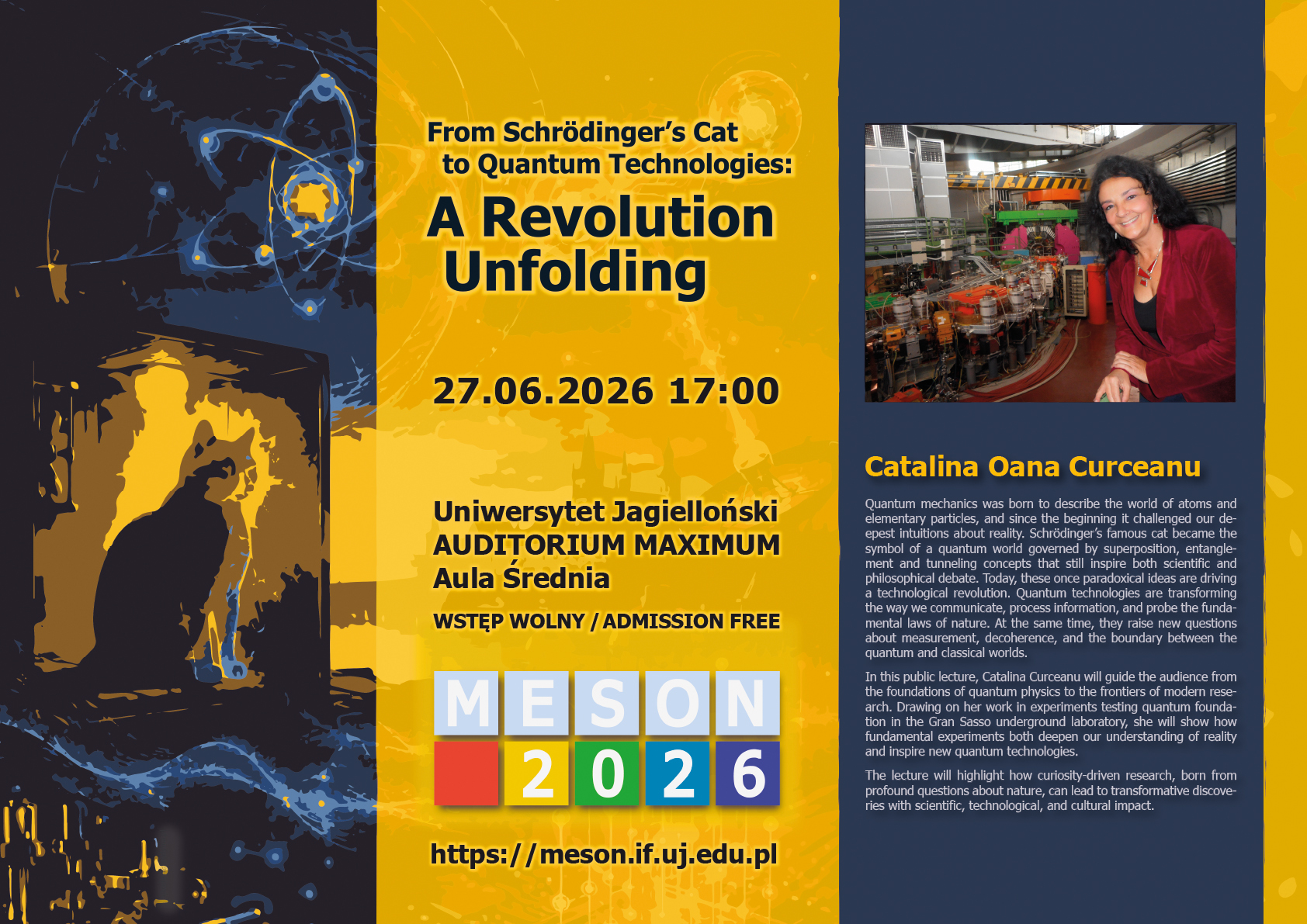
Speaker
Description
Kaonic atoms, exotic systems in which a negatively charged kaon replaces an electron, provide a unique laboratory for probing both the strong and electromagnetic interactions. The X-ray transitions emitted during their atomic cascade are modified by the strong interaction in the innermost levels, enabling precision studies of kaon–nucleon and kaon–nucleus interactions and offering direct access to non-perturbative QCD in the strangeness sector.
In addition, transitions between high principal quantum number (high-n) levels, governed purely by quantum electrodynamics (QED), can be exploited to test bound-state QED (BSQED) in regimes of extremely strong electromagnetic fields. These studies extend beyond the Schwinger critical field, providing access to QED under extreme conditions that are currently inaccessible in ordinary atomic systems.
The SIDDHARTA-2 collaboration, exploiting the high-quality low-energy kaon beam delivered by the DAΦNE collider at Frascati (Italy) and state-of-the-art fast, high-resolution X-ray detectors such as Silicon Drift Detectors (SDDs), has performed unique high-precision X-ray spectroscopy of a series of kaonic atoms. This program includes measurements of kaonic helium-4, neon, and, for the first time, deuterium, providing essential experimental input for low-energy QCD in the strangeness sector.
In this contribution, I will present the scientific case, the experimental techniques, and the latest results from SIDDHARTA-2. I will discuss the impact of these measurements on our understanding of non-perturbative QCD and highlight the promising role of kaonic atoms in future BSQED investigations under extreme field conditions. I will conclude by outlining future perspectives for systematic kaonic-atom measurements at DAΦNE and/or J-PARC, together with the rapidly evolving enabling radiation-detector technologies.
| Collaboration | SIDDHARTA-2 |
|---|