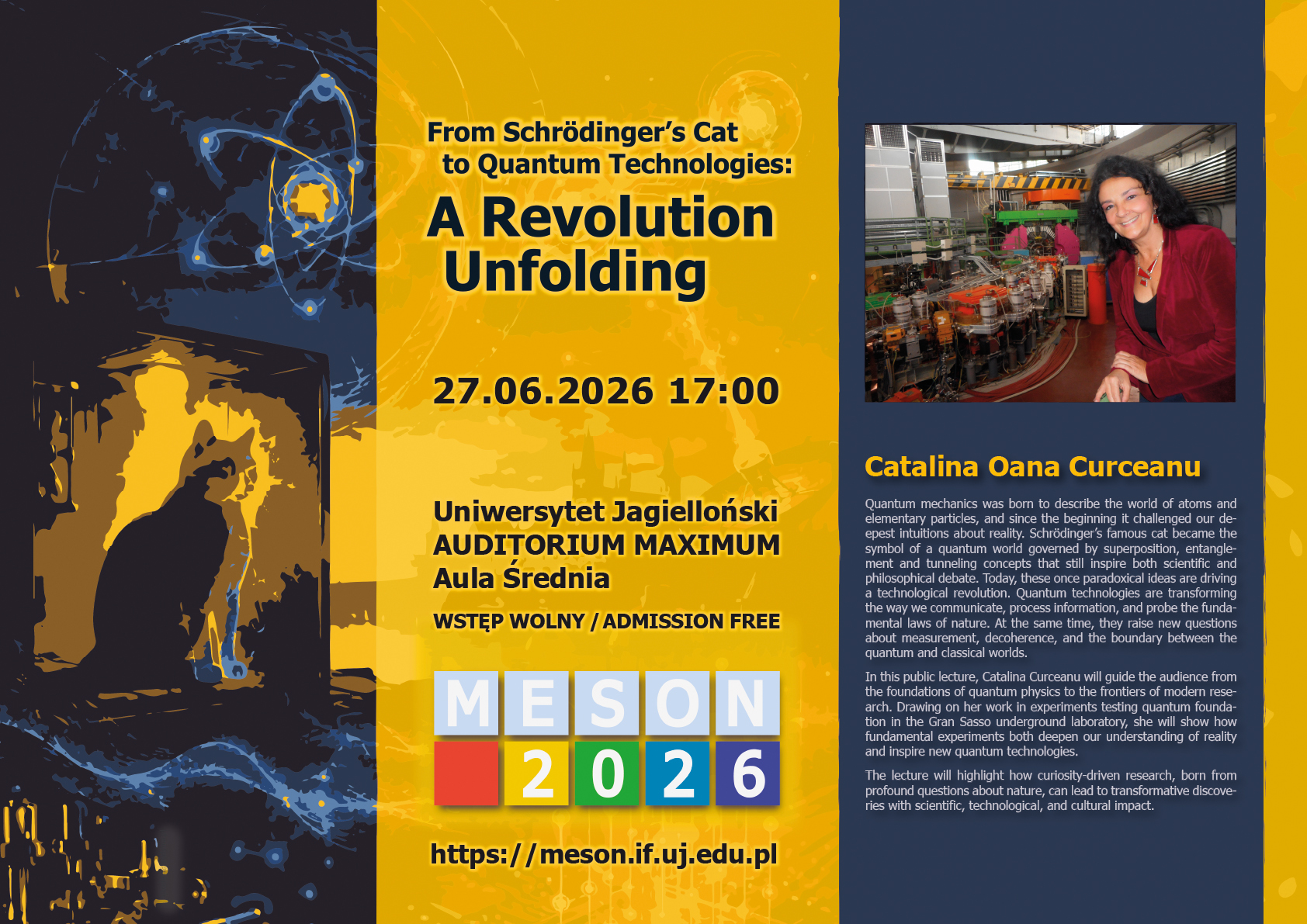
Speaker
Description
Understanding the interaction between strange baryons and nucleons is essential for describing dense baryonic matter. In neutron star interiors, the presence of hyperons is expected to significantly soften the equation of state (EoS), thereby reducing the maximum mass such stars can support. Addressing this problem requires improved constraints not only on two-body interactions but also on multi-body hyperonic forces. So far, efforts to include three-body contributions have largely relied on limited experimental input from hypernuclei, where existing data are less precise than theoretical predictions and remain particularly scarce for $\Xi^-$ systems.
Femtoscopic measurements in high-energy collisions at the LHC offer a novel and complementary approach to probe hyperon–nucleon–nucleon interactions. In particular, preliminary theoretical studies of the p–p–$\Lambda$ correlation function indicate sensitivity to three-body forces, with potentially sizable effects. In this contribution, recent measurements and developments in the study of p–p–$\Lambda$ correlations across different collision systems are presented. Comparisons between systems and event centralities provide insight into how the sensitivity to three-body forces evolves with the size of the emitting source. In addition, new results on p–p–$\Xi^-$ correlations, probing systems with double strangeness, are discussed together with future perspectives.