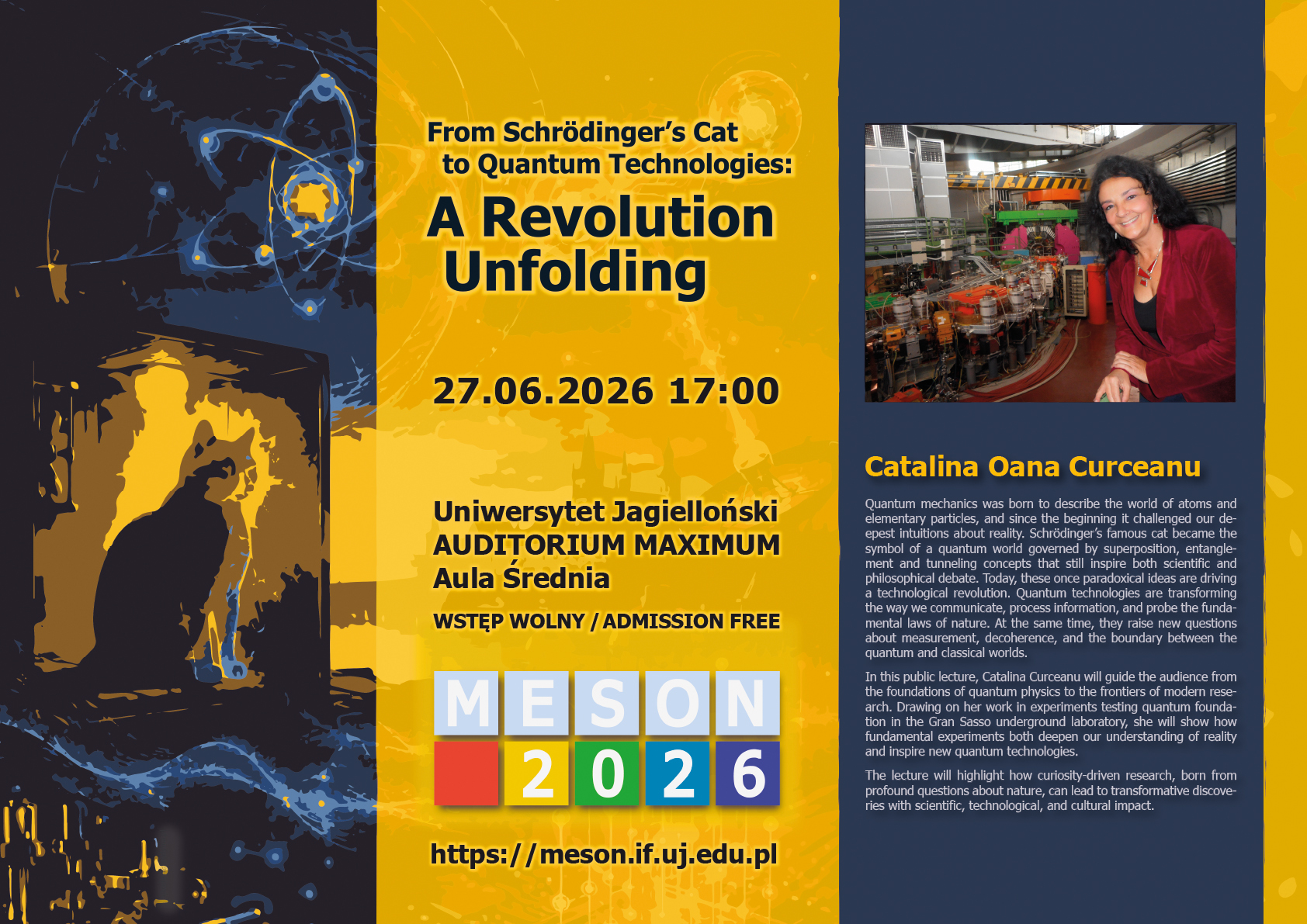
Speaker
Description
Open problems in particle physics, e.g. the strong CP problem, the nature of dark matter, baryon asymmetry, and anomalies in nuclear transitions [1,2], motivate searches for light weakly coupled particles: ALPs, dark photons, and hidden sector mediators [3]. Light pseudoscalar mesons $\eta$ and $\eta'$ ($J^{PC} = 0^{-+}$) provide a uniquely clean environment for such searches, with suppressed SM backgrounds, rich radiative and leptonic decay channels, and sensitivity to CP-odd phases in the final state.
Over the past two decades, a series of dedicated experiments has established $\eta$ and $\eta'$ mesons as precision probes of BSM physics. Studies at WASA-at-COSY, KLOE-2, and BESIII have progressively refined sensitivity to CP-violating observables, dark photon production, and ALP signatures, reaching branching ratio limits at the $10^{-5}$-$10^{-7}$ level [4-7]. In parallel, the HADES experiment at GSI contributes precision dielectron spectroscopy in hadronic fixed-target collisions,probing the ALP-relevant low-mass $e^+e^-$ region [8].
The most significant future advance will come from REDTOP [9], targeting production rates of $10^{13}$~$\eta$ and $10^{12}$~$\eta'$ per year at high-intensity proton or pion beams. This would push accessible branching ratios to the $10^{-11}$-$10^{-12}$ level, probe ALP-electron couplings at $g_{Ae} \sim 10^{-7}$, and reach CP asymmetries at the $10^{-4}$ level, covering the viable QCD-axion space in the MeV range and discriminating between competing explanations for BSM physics.
This talk presents an experimental overview of current results and the physics potential of future $\eta$ and $\eta'$ programs, with emphasis on the interplay between achievable meson yields, detector performance, and sensitivity to ALPs, dark mediators, and CP violation.
References
[1] A.J. Krasznahorkay et al., Phys. Rev. Lett. 116, 042501 (2016).
[2] J.L. Feng et al., Phys. Rev. Lett. 117, 071803 (2016).
[3] B. Batell, M. Pospelov, A. Ritz, Phys. Rev. D 80, 095024 (2009).
[4] P. Adlarson et al. (WASA-at-COSY), Phys. Rev. C 94, 065206 (2016).
[5] P. Adlarson et al. (WASA-at-COSY), Phys. Lett. B 726, 187 (2013).
[6] A. Anastasi et al. (KLOE-2), JHEP 05 (2016) 019.
[7] M. Ablikim et al. (BESIII), arXiv:2501.10130 [hep-ex].
[8] G. Agakishiev et al. (HADES), Eur. Phys. J. A 41, 243 (2009).
[9] M. Zielinski, C. Gatto, Acta Phys. Polon. Suppl. 18, 4-A5 (2025).