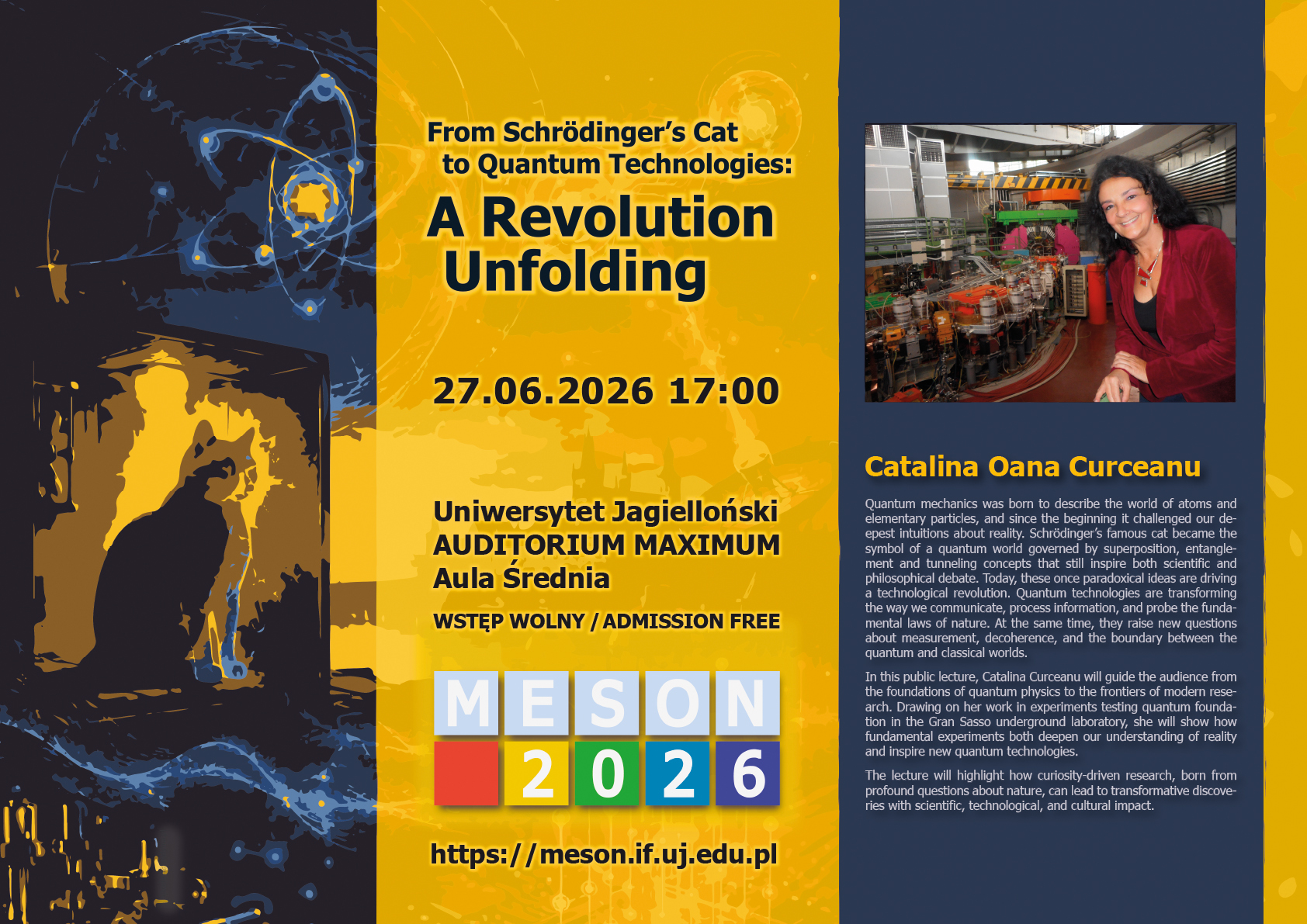
Speaker
Description
Femtoscopy provides indirect access to fundamental QCD phenomena beyond vacuum interactions, particularly chiral symmetry breaking and its partial restoration, through its sensitivity to hadron--hadron interactions. In vacuum, spontaneous chiral symmetry breaking leads to distinct hadronic excitations and nondegenerate spectral functions, such as those of the $\rho$ and $a_1$ mesons. In a nuclear medium, the reduction of the quark condensate modifies these spectral functions, inducing broadening, possible mass shifts, and eventual overlap, which signals partial chiral symmetry restoration. A quantitative description of these effects requires reliable input on vector--baryon interactions, notably the $\rho$--$N$ system.
Recent femtoscopic measurements of $\phi$--$p$ and $\rho^0$--$p$ correlation functions~\cite{ALICE:2021cpv,ALICE:2025flv} provide the first direct access to interactions of short-lived vector mesons. While initial analyses relied on the Lednicky--Lyuboshitz approximation~\cite{Lednicky:1981su}, later studies~\cite{Feijoo:2024bvn,Abreu:2024qqo} demonstrate the need for fully unitary coupled-channel approaches to reliably extract scattering parameters. Building on measurements in the $S=0$ sector, current efforts extend to systems with nonzero strangeness~\cite{Encarnacion:2025luc,Lin:2025mtz}, where near-threshold states and coupled-channel dynamics are expected to play a key role. The strong sensitivity of correlation functions to these effects establishes femtoscopy as a versatile tool to study hadronic interactions, exotic states, and threshold phenomena across flavor sectors. The content of this latter set of developments will be addressed in detail in my talk.