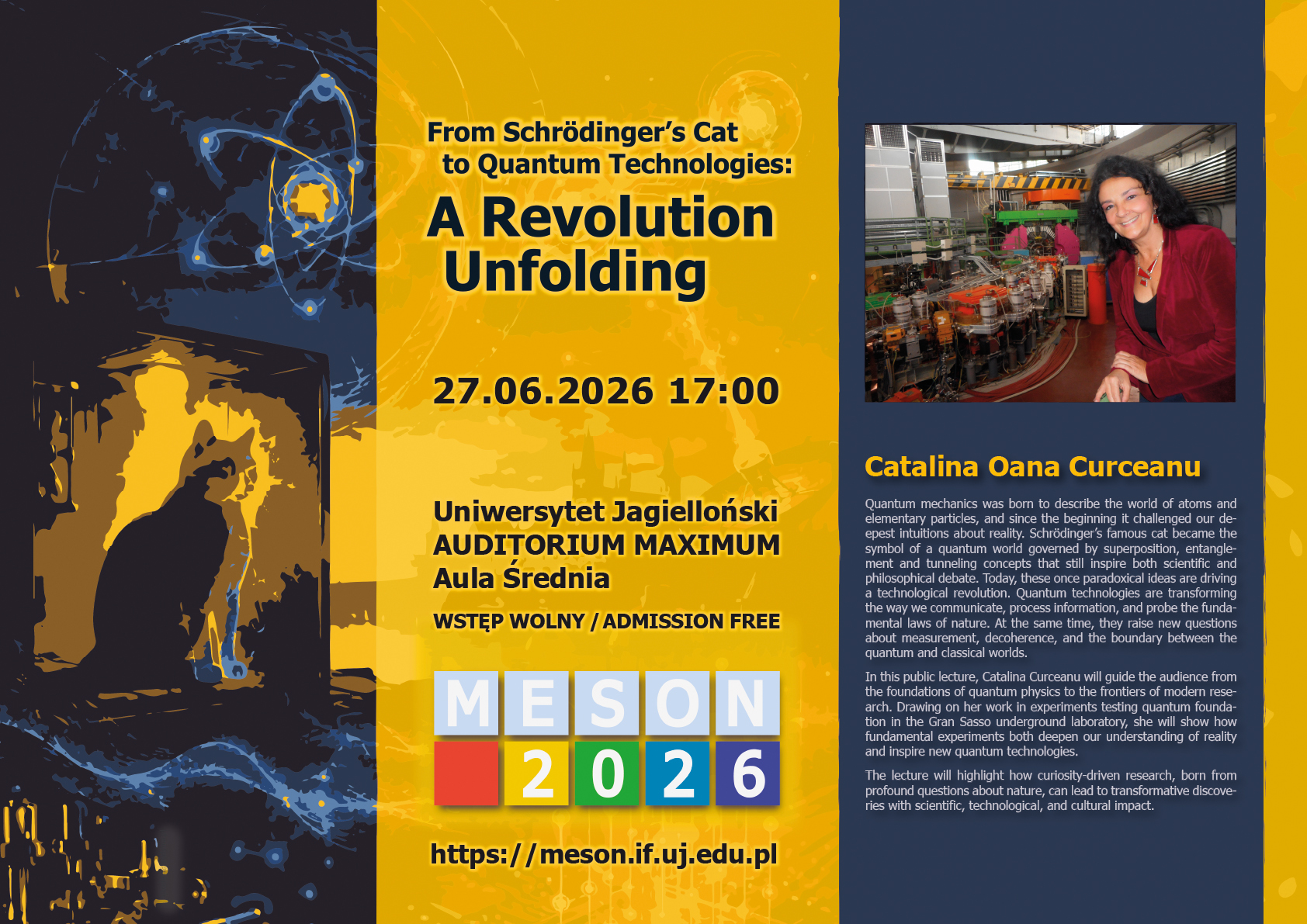
Speaker
Description
Observation of a family of all-charm tetraquarks with spin-2 and positive parity
Three structures, denoted as X(6600), X(6900), and X(7100), have been observed in the J/\psi J/\psi mass spectrum and are interpreted as candidates for a family of fully-charm tetraquark states. Using proton-proton collision data collected by the CMS detector corresponding to an integrated luminosity of 315 fb(^{-1}), the J/\psi J/\psi spectrum is studied with substantially improved statistical precision. All three structures, as well as their interference, are found with statistical significances exceeding five standard deviations. The observed interference indicates that these states share common quantum numbers. Their squared masses show an approximately linear dependence on the resonance index, while their natural widths decrease systematically with increasing index, suggesting a pattern consistent with radial excitations of tetraquarks composed of two aligned spin-1 diquarks without orbital excitation. Complementary studies in the J/\psi\psi(2S)\to\mu^+\mu^-\mu^+\mu^- final state further reveal structures associated with the X(6900) and X(7100) states. This talk further presents a dedicated spin-parity analysis of the near-threshold structures in the fully-charm tetraquark sector using the J/\psi J/\psi\to4\mu final state. A matrix-element-based approach is employed to test multiple J^P hypotheses, including (0^+), (0^-), (1^+), (1^-), (2^+), and (2^-), based on the kinematic distributions of the four-muon system. The primary analysis uses decay-only observables, while production angular distributions are also examined as a consistency test. The results favor the quantum-number assignment J^{PC}=2^{++}, establishing the first spin-parity determination of a fully-charm tetraquark family at a hadron collider and providing important constraints on the internal structure and excitation pattern of exotic hadrons.