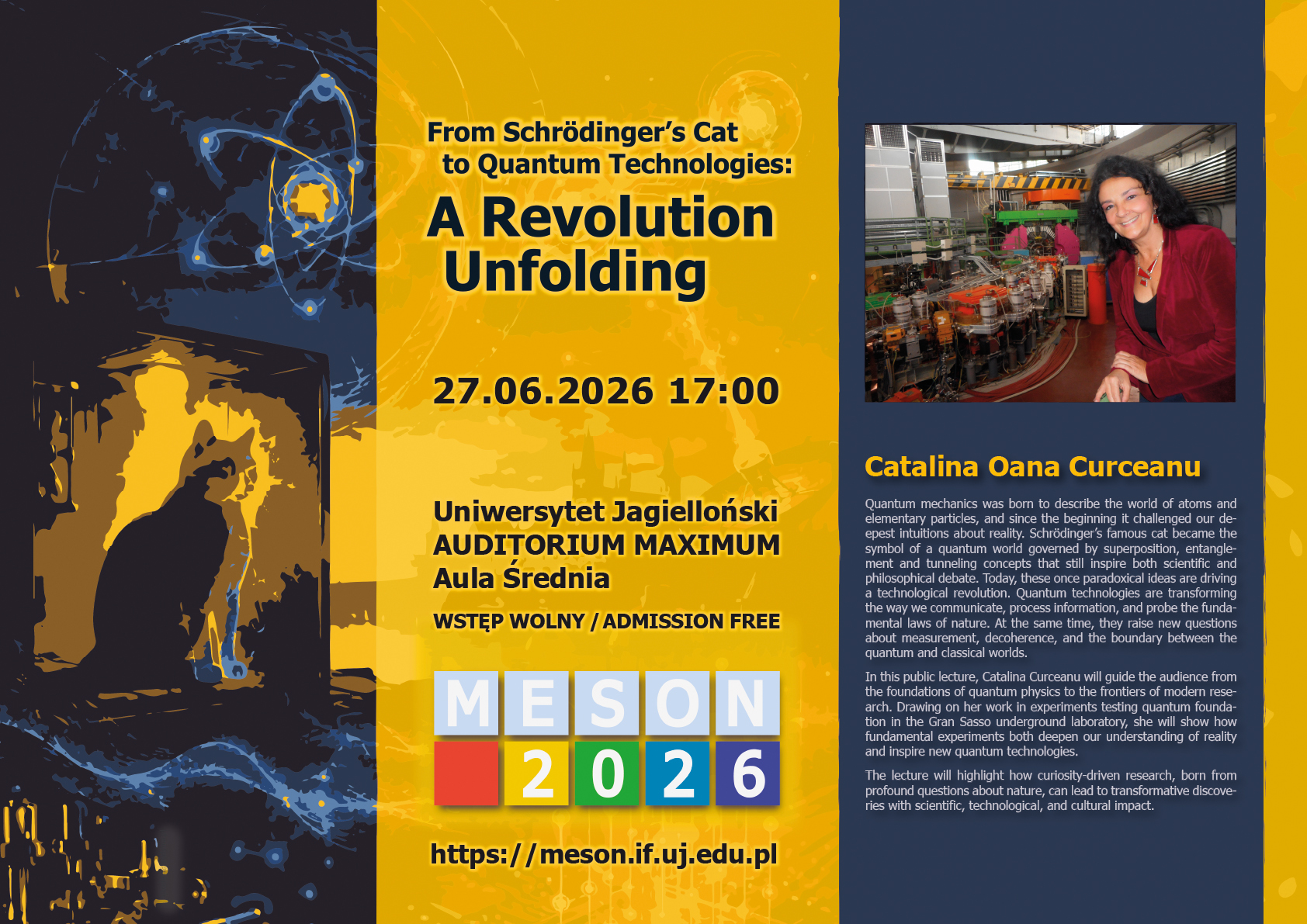
Speaker
Description
A polarized antiproton beam would open a broad physics program relevant to meson and hadron-structure studies, ranging from a direct determination of the spin-dependent components of the $\bar{p}p$ total cross section and of spin-flip amplitudes of the antinucleon-nucleon ($\bar{N}N$) interaction to a measurement of the transversity distribution via polarized Drell-Yan processes, as proposed by the PAX collaboration. It would also provide unique access to spin observables in $\bar{p}p$ annihilation into mesonic final states, including light and charmonium systems, complementing ongoing programs with polarized protons. Despite decades of effort, no efficient method for producing polarized antiproton beams suitable for long measurement campaigns has been established. A particularly attractive possibility is that the antiproton production process itself generates a non-zero transverse polarization, in analogy with the well known polarization of $\Lambda$ and other hyperons produced in unpolarized $pp$ and $pA$ collisions, where values of 20-30% have been reported. Despite the different production mechanisms, spin-dependent nonperturbative QCD dynamics may give rise to an analogous effect in the baryon-antibaryon sector, which has never been tested experimentally. If confirmed, a polarized secondary beam could be prepared by selecting a narrow azimuthal region of the production cone, without additional spin manipulation techniques.
The P371 experiment at the T11 beam line at CERN PS aims to determine the antiproton polarization, if it exists, using secondary antiprotons at 3.5 GeV/$c$ produced with the primary 24 GeV/$c$ proton beam. The transverse polarization is accessed via the left-right asymmetry of elastic $\bar{p}p$ scattering in the Coulomb Nuclear Interference region (CNI), where the analyzing power is predicted to reach $4.5$% based on one-boson exchange calculations of the $\bar{N}N$ potential. The detection setup combines scintillator triggers, an aerogel Cherenkov veto for $\pi^{-}$ rejection, a scintillating fiber hodoscope, a liquid hydrogen analyzer target, straw tube trackers, and a DIRC detector for offline $\pi^{-}/\bar{p}$ identification. Detailed Monte Carlo studies, recently published in Eur. Phys. J. C 86, 390 (2026), show that with an integrated luminosity of $\sim\!1.18$ nb$^{-1}$ ($\sim$8 weeks of data taking), a polarization of 12% can be distinguished from the null hypothesis at the $5\sigma$ level and 7% at the $3\sigma$ level, within the optimal angular range $6.7 < \theta < 35$~mrad.
This talk presents the physics motivation for polarized antiproton beams, the P371 experimental setup, and the sensitivity studies, together with the status of the first test runs at the T11 beam line.
[1] D. Alfs et al., Eur. Phys. J. C 86, 390 (2026).
[2] P. Lenisa, F.Rathmann (PAX Coll.), arXiv:nucl-ex/0512021.
[3] K. Kilian et al., Int. J. Mod. Phys. A 26, 757 (2011).
[4] E. Klempt et al., Phys. Rep. 368, 119 (2002).
[5] E. Ramberg et al., Phys. Lett. B 338, 403 (1994).
[6] A. Bravar et al., Phys. Rev. Lett. 77, 2626 (1996).
| Collaboration | CERN/P371 |
|---|