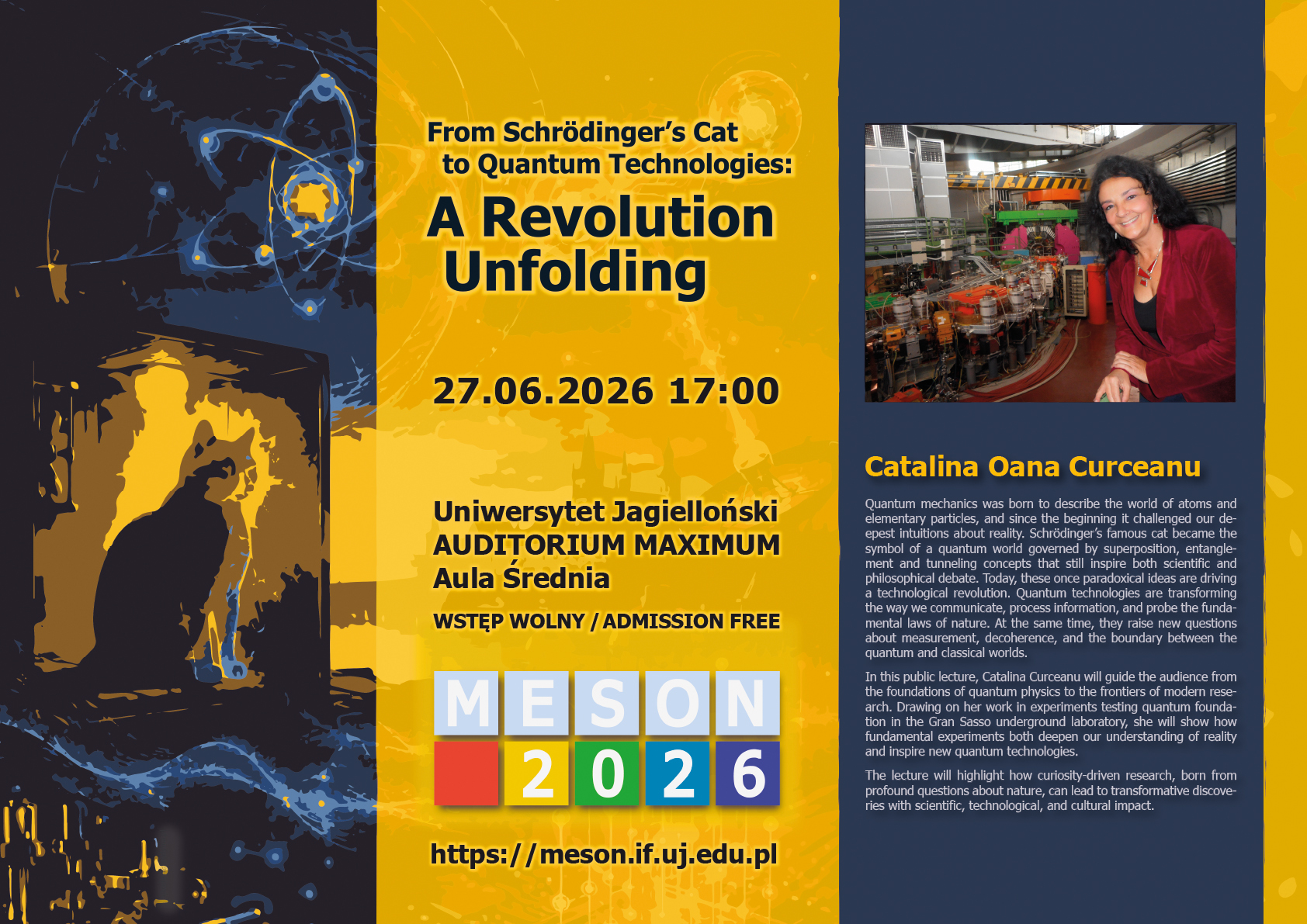
Speaker
Description
The study of the baryon-baryon interaction is a basic tool to investigate the strong interaction. Especially in the strangeness $S = -2$ sector the available data are strongly limited. Most studies in this field were devoted to the search for the $H$-particle, a $(B = 2, S = -2)$ system with the quark configuration $(uuddss)$ first proposed by Jaffe [1]. Experimentally, $S = -2$ baryonic systems are accessed predominantly through the cascade hyperon $\Xi$, produced in $K^-$- or $p$-induced reactions. Slow $\Xi$ particles can go into interacting $\Xi N$ systems which can couple to $YY$ or might also directly connect to the $H$ particle [2].
With stopped antiprotons a very efficient reaction chain for the production of slow $\Xi$ hyperons can be initiated. In a first step a $\bar{K}^*$ beam is produced in the annihilation of a stopped antiproton on a nucleon. The production of $S = -2$ systems proceeds then in a second step via the double strangeness and charge exchange reaction $(\bar{K}^*, K)$. Due to the short decay length of a few fm both, $\bar{K}^*$ production and the double strangeness and charge exchange reaction have to take place in the same nucleus. The special feature of this reaction channel is the low momentum of the produced $\Xi$ hyperon. The magic $\bar{K}^*$ momentum at which the $\Xi$ can be produced at rest is at around 200~MeV/c which is very close to the momentum of the produced $\bar{K}^*$ in the first reaction step.
The initial measurements will focus on pure $\Xi$ production, exemplified by the reaction $\bar{p}d \rightarrow \Xi^- K^0_s K^{*+}$. To investigate the $\Xi N$, $\Lambda\Lambda$ or $H$ systems a $^3$He target has to be used. The slow $\Xi$ hyperons with recoil momenta down to even zero MeV/c have a high probability of producing a $(B = 2, S = -2)$ system. A further extension of the programme may be the production of double hypernuclei. With the technique of recoil-free kinematics the $\Xi$ can also be produced and deposited in more extended nuclei. A highly efficient production of double hypernuclei is expected with this method. From the experimental point of view the delayed decays of the strange exit particles allows a highly selective trigger on these reaction channels and the event reconstruction is relatively simple. A non-magnetic detection system with track reconstruction ability is sufficient for the complete kinematical reconstruction.
The CERN AD facility provides a unique opportunity to realize such a programme. Antiprotons with well defined low emittance beam, makes the $(\bar{K}^*, K)$ reaction on light nuclear targets such as deuterium and $^3$He experimentally accessible with realistic statistics. A dedicated setup based on a cryogenic gas target surrounded by a non magnetic tracking system would provide the first systematic measurement of $S = -2$ baryonic systems produced at rest, offering a unique low-background environment for the search of the $H$-dibaryon and double hypernuclei.
In this contribution, the physics motivation and the proposed experimental concept for such a programme at the CERN AD facility will be presented.
References:
[1] R.L. Jaffe, Phys. Rev. Lett. 38 (1977) 195.
[2] K. Kilian, Proc. 4th LEAR Workshop (1988) 529; K. Kilian et al., Memorandum
PSCC CERN (1990).