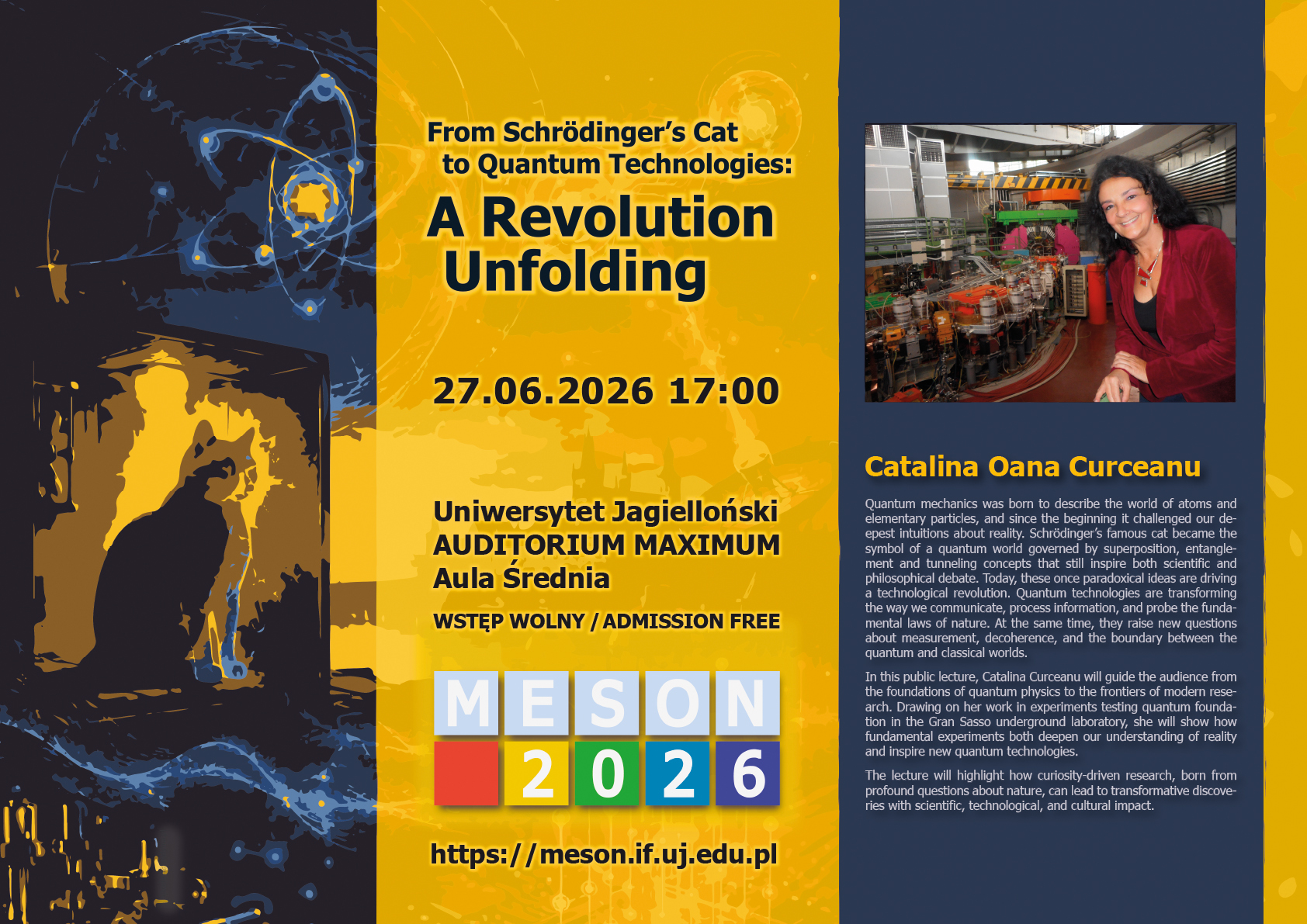
Speaker
Description
Precision measurements of simple leptonic systems offer a powerful approach to testing fundamental symmetries and exploring physics beyond the Standard Model. This study focuses on the ortho-positronium (o-Ps) state, which predominantly decays into three photons. Owing to the absence of hadronic effects,positronium provides a uniquely clean system for precise tests of Quantum Electrodynamics.High-precision measurements of the o-Ps lifetime enable stringent tests of QED predictions and offer sensitivity to new physics, such as Mirror Matter (MM), a potential dark matter candidate [1].
We present ongoing analysis of the o-Ps decay rate using the modular J-PET setup [2, 3, 4], optimized for high-resolution timing and angular measurements. Dedicated reconstruction algorithms and Monte Carlo simulations are employed to identify three-photon annihilation events and suppress background contributions.
The primary goal is a high-precision determination of the o-Ps lifetime. Any deviation from QED predictions may indicate oscillations into mirror states, enabling constraints on the photon–mirror photon kinetic mixing parameter. The experiment aims to improve sensitivity by at least one order of magnitude with respect to present values $\Gamma = 7.039979(11) \times 10^6 s^{-1}$ [5], allowing for competitive constraints on mirror matter models and other scenarios involving invisible decay channels.
We acknowledge support from the National Science Centre of Poland through Grants No. 2019/35/B/ST2/03562, 2020/38/E/ST2/00112, SPUB/SP/627733/2025 and the SciMat and qLife Priority Research Area budget under the auspices of the program Excellence Initiative-Research University at Jagiellonian University. We also acknowledge Polish high-performance computing infrastructure PLGrid (HPC Center: ACK Cyfronet AGH) for providing computer facilities and support within computational grant no. PLG/2024/017688 and PLG/2025/018762.
References
[1] C. Vigo et al. Physical Review Letters, 124(10):101803, 2020.
[2] F. Tayefi et al. Bio-Algorithms Med-Syst., 19:133–139, 2023.
[3] P. Moskal et al. Sci. Adv., 7:eabh4394, 2021.
[4] P. Moskal et al. Sci. Adv., 10:adp2840, 2024.
[5] G. S. Adkins et al. Ann. Phys. (N. Y.), 295(2):136–193, 2002.
| Collaboration | J-PET |
|---|