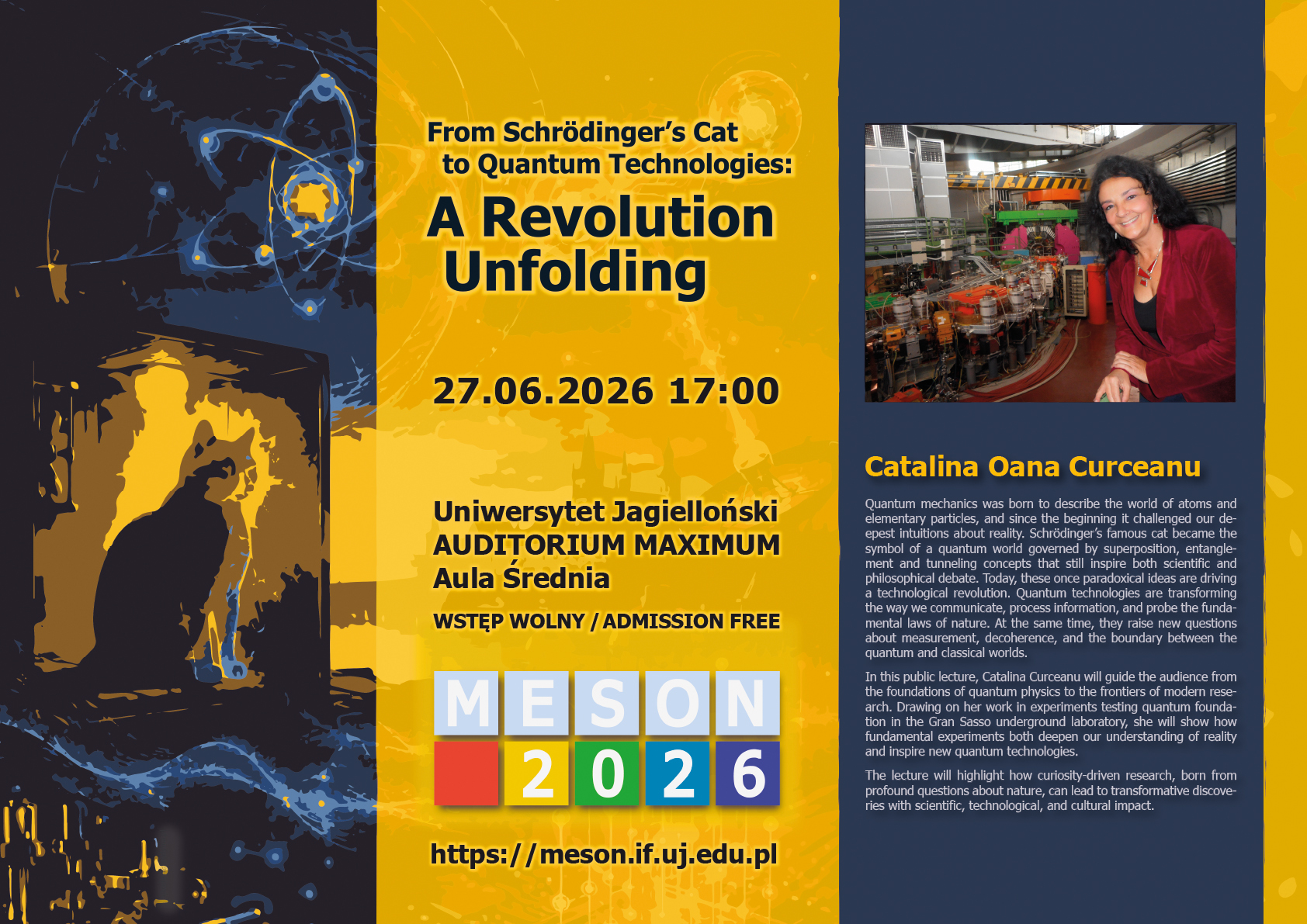
Speaker
Description
Excited nucleon states ($N^*$ and $\Delta$ resonances) provide an important probe of the non-perturbative regime of Quantum Chromodynamics (QCD) and the internal structure of baryons. In this work, we study the production mechanisms of these resonances in the reaction $pp\rightarrow NN\pi$, which also serves as a baseline for interpreting heavy-ion collision data. The High Acceptance Di-Electron Spectrometer (HADES) at GSI Darmstadt, a versatile magnetic spectrometer with large angular acceptance, is well suited for such studies.
This analysis focuses on the exclusive production of $N^*$ and $\Delta$ channels in proton–proton collisions at $\sqrt{s}=3.47$ GeV and aims to extract their coupling strengths. We present results from the analysis of proton–proton scattering data collected by the HADES collaboration in February 2022, together with preliminary comparisons to fits obtained using the Jülich–Bonn (JüBo) dynamical coupled-channel model. Finally, we discuss the applicability of the fitting framework, implemented with AmpTools, to other exclusive channels, including reactions involving strangeness.
| Collaboration | HADES |
|---|