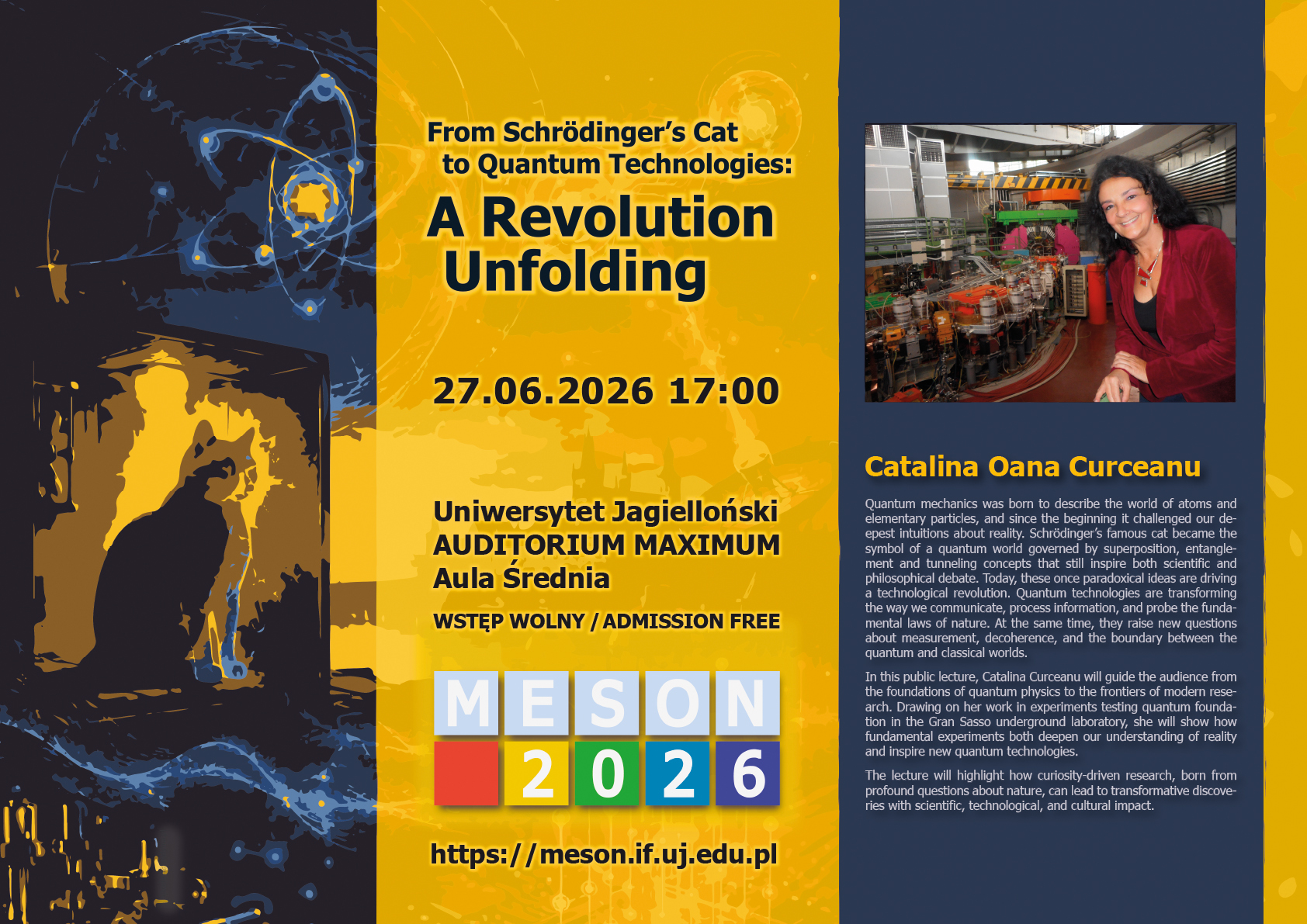
Speaker
Description
The masses of mesons belonging to the nonet of pseudoscalar mesons are closely related to fundamental symmetry breaking in QCD. The $\eta^{\prime}$ meson, in particular, has an anomalously large mass due to the axial U(1) anomaly arising from nonperturbative gluon dynamics in the QCD vacuum. In the nuclear medium, where chiral symmetry is partially restored, a mass reduction of the $\eta^{\prime}$ meson is predicted in a range of 1--150 MeV/$c^2$ depending on the theoretical model, leading to an attractive potential between the $\eta^{\prime}$ meson and a nucleus. Consequently, the formation of $\eta^{\prime}$-mesic nuclei, bound states of the $\eta^{\prime}$ meson with a nucleus, is expected if the mass reduction is sufficiently large.
To search for $\eta^{\prime}$-mesic nuclei, we measured the excitation spectrum of the $^{12}\mathrm{C}(p,d)$ reaction near the $\eta^{\prime}$ meson production threshold at the FRS in GSI. We employed a 2.5 GeV proton beam incident on a 4 g/cm$^2$ $^{12}\mathrm{C}$ target. The momenta of the ejectile deuterons were measured using the FRS and $\sim$1 GeV/$c$ protons emitted backward from the decay of $\eta^{\prime}$-mesic nuclei via the two-nucleon absorption process ($\eta^\prime NN\to NN$) were simultaneously tagged using the WASA detector.
We obtained the excitation spectrum of the $^{12}\mathrm{C}(p,d)$ reaction near the threshold with an experimental resolution of 1.6 MeV, in coincidence with the 1 GeV/$c$ protons detected in the WASA detector. The observed spectrum exhibited two structures below the threshold, suggesting the possible formation of $\eta^{\prime}$-mesic nuclei. We fitted the spectrum with a sum of a theoretically calculated spectra and a 3rd-order polynomial by scanning the real and imaginary parts of the $\eta^{\prime}$-$^{11}\mathrm{C}$ optical potential, $V_0$ and $W_0$ respectively. A null-hypothesis testing was performed to evaluate the statistical significance, resulting in local and global significances of 3.5$\sigma$ and 2.1$\sigma$, respectively. The analysis result indicated $V_0=-61\pm1\pm5$ MeV and $|W_0|\le10$ MeV (68\% C.L.).
In this presentation, we discuss the details of the experiment, the data analysis, and the result of the experiment.
| Collaboration | $\eta$-PRiME Collaboration and Super-FRS Experiment Collaboration |
|---|