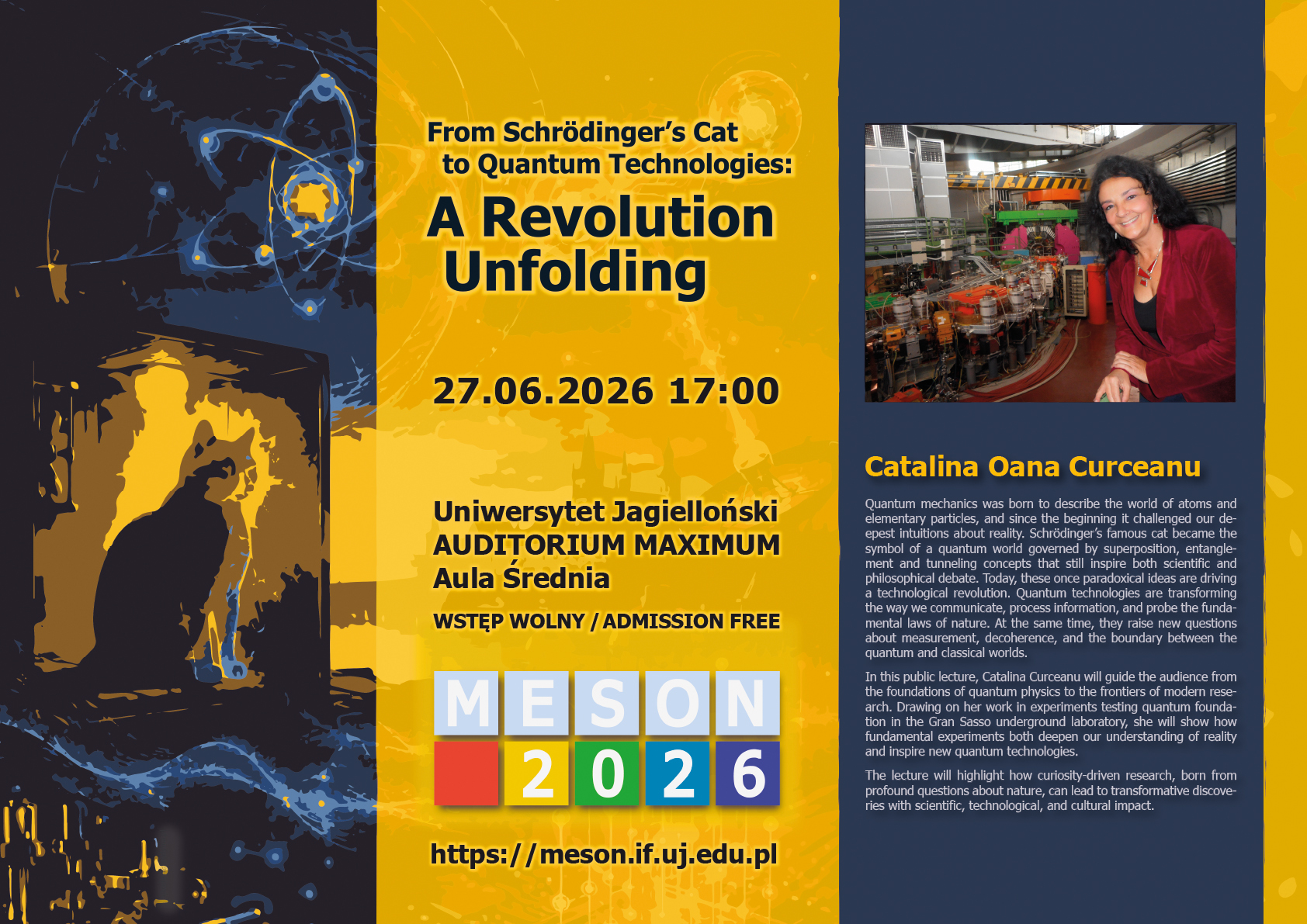
Speaker
Description
This talk presents the study of the strangeness production mechanisms in the reaction $pp \to ppK^{+}K^{-}$ reaction, analyzed using data collected with the HADES detector and a 4.5 GeV proton beam. The event selection is based on the particle identification, employing a domain-adversarial neural network, and a kinematic refit imposing four-momentum conservation. This results in the purity of the final sample reaching $S/B \approx 30$.
Clear contributions from $\phi(1020)\!\to\!K^{+}K^{-}$ and $\Lambda(1520)\!\to\!pK^{-}$ are observed, with masses and widths consistent with the PDG data. The differential cross sections are obtained and used in the amplitude and angular analyzes, yielding a number of observables such as non-resonant enhancement in the effective $pK^-$ and $K^+K^-$ FSI scattering-length parameterization and vector meson $\phi(1020)$ spin density matrix elements. Additionally, strong meson-baryon coupling forming the $\Lambda(1405)$ is investigated in the K-matrix formalism with two channels $pK^-$ and $\Sigma^0\pi^0$. This talk focuses on the interpretation of the recent results, comparing the production dynamics insights with the previous studies closer to the production threshold.
| Collaboration | HADES |
|---|