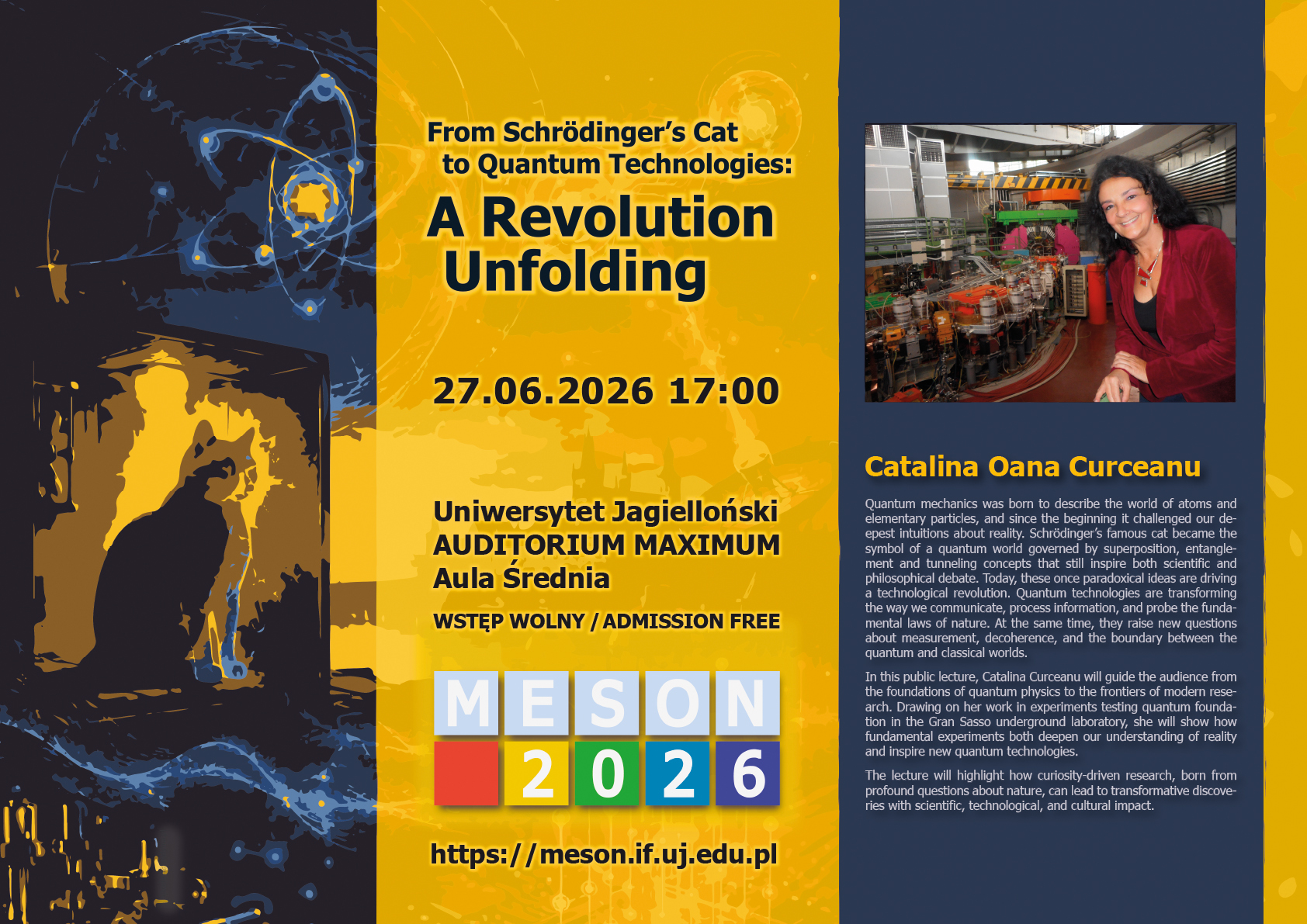
Speaker
Description
In a recent paper [1], we generalized our chirally motivated $\pi\Sigma - \bar{K}N$ coupled channels model [2] to the cubic finite volume and used it to calculate the stationary energy spectrum that appears in a nice agreement with the spectrum obtained in the lattice QCD simulations by the BaSc collaboration [3, 4]. Interestingly, the hadron masses used by the BaSc collaboration were also found quite close to the mass trajectories adopted in [2] when going to the SU(3) flavor symmetric point.
Several other comparisons with the BaSc results were made in [1]. In particular, we demonstrated that the two poles of the scattering matrix found in the complex energy plane by the BaSc collaboration, a resonance just below the $\bar{K}N$ threshold and another one on the real axis close to the $\pi\Sigma$ threshold, transform into the standard two pole picture of the $\Lambda(1405)$ resonance when one reconciles gradually the LQCD hadron masses (and meson decay constants) with their physical values. We have also shown that the relatively large pion mass used in the LQCD simulations represents the main reason why one of the resonance poles degenerated into a virtual state reported by the BaSc collaboration.
References:
[1] P.C. Bruns, A. Cieplý, Eur. Phys. J. A 61, 44 (2025)
[2] P.C. Bruns, A. Cieplý, Nucl. Phys. A 1019, 122378 (2022)
[3] J. Bulava et al. (BaSc collaboration), Phys. Rev. Lett. 132, 051901 (2024)
[4] J. Bulava et al. (BaSc collaboration), Phys. Rev. D 109, 014511 (2024)