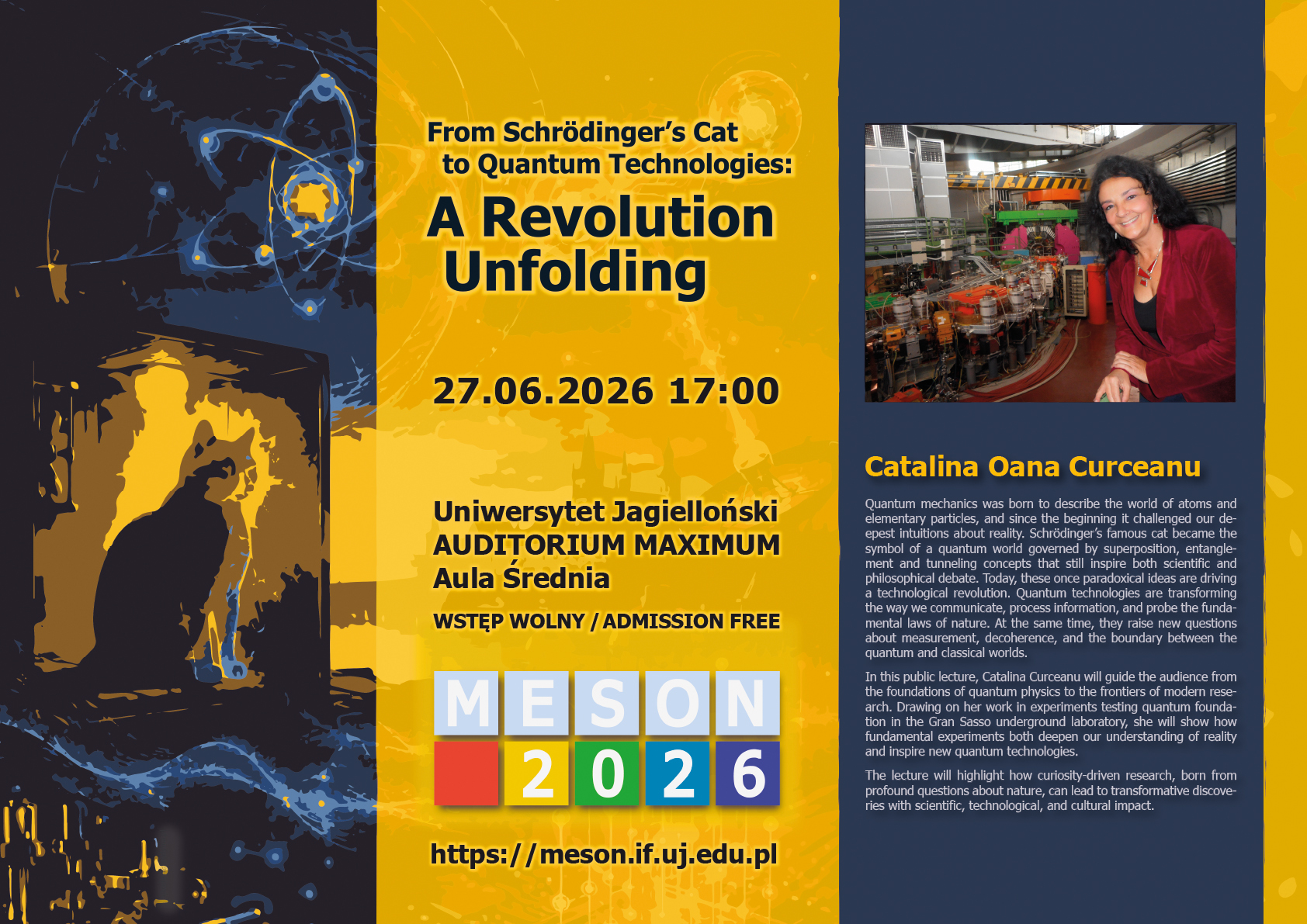
Speaker
Description
This contribution describes plans and performance studies for the upcoming pion beam program at GSI. The program will utilize high-intensity secondary pion beams ($< 2.8$ GeV/$c$) in conjunction with the High-Acceptance Di-Electron Spectrometer (HADES), which offers large geometric acceptance, high positional and time-of-flight resolution, as well as dedicated dilepton detection capabilities. Aim is to probe the non-perturbative regime of QCD. This initiative is designed to advance our understanding of baryon spectroscopy and structure through precision measurements of baryon-meson coupling constants and electromagnetic transition form factors in the time-like region. The anticipated beam intensities will facilitate comprehensive partial wave analyses and the exploration of rare decay modes, providing critical insights into hadron dynamics and contributing to the refinement of dilepton emission models in heavy-ion collisions.
A key aspect of the program is the investigation of vector meson properties in cold nuclear matter via dielectron spectroscopy, offering a unique window into in-medium modifications and their connection to chiral symmetry restoration. By integrating nuclear, hadron, and heavy-ion physics, this program aligns with the overarching “QCD at FAIR” roadmap, while also complementing global efforts at photon beam facilities. The results are expected to deepen our knowledge of QCD-driven phenomena and foster collaboration across diverse physics communities.
| Collaboration | HADES |
|---|