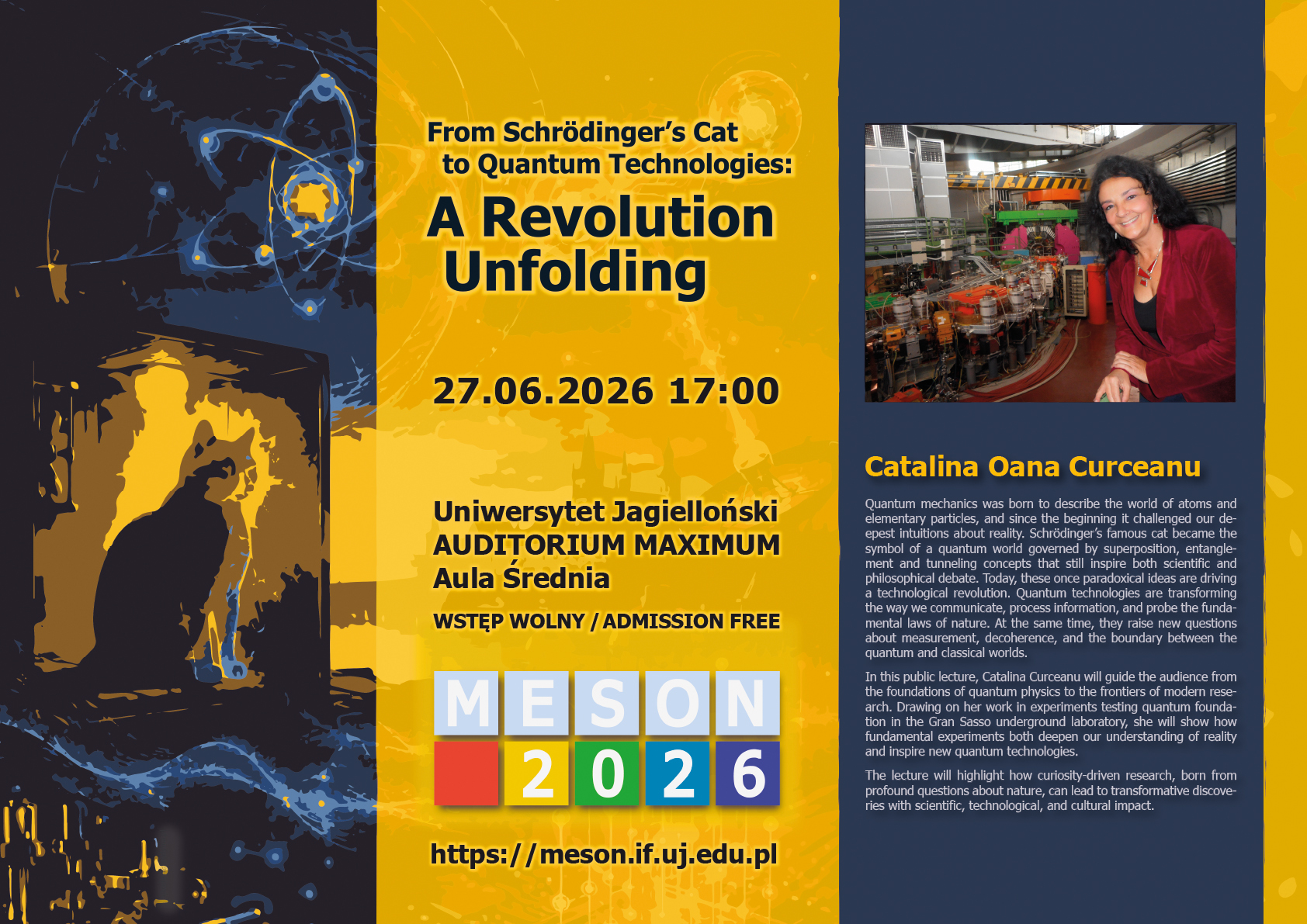
Speaker
Description
The production of $\eta\pi$ and $\eta^\prime\pi$ has been studied by COMPASS using a ${190}{\,\text{GeV}/c}$ pion beam from CERN SPS. The corresponding partial-wave decompositions (PWD) show a pronounced peak in the exotic $J^{PC}=1^{-+}$ $P$-wave at around ${1.4}{\,\text{GeV}/c^2}$ in the $\eta\pi$ channel and around ${1.65}{\,\text{GeV}/c^2}$ in the $\eta^\prime\pi$ channel. In the $\eta\pi$ final state, the strong dominance of the $a_2(1320)$ enhances possible feed-through into other partial waves. This becomes particularly evident in the $J^{PC}=4^{++}$ $G$-wave, where an unphysical peak appears in the mass region around ${1.3}{\,\text{GeV}/c^2}$.
In this work, we perform a systematic input–output study to investigate this leakage effect using generated pseudo data. The pseudo data samples are produced with a fully controlled input model, allowing us to investigate the origin of the leakage peak in detail. Thus, systematic effects of the PWD like incomplete acceptance corrections or certain model assumptions my be studied in detail.
| Collaboration | COMPASS |
|---|