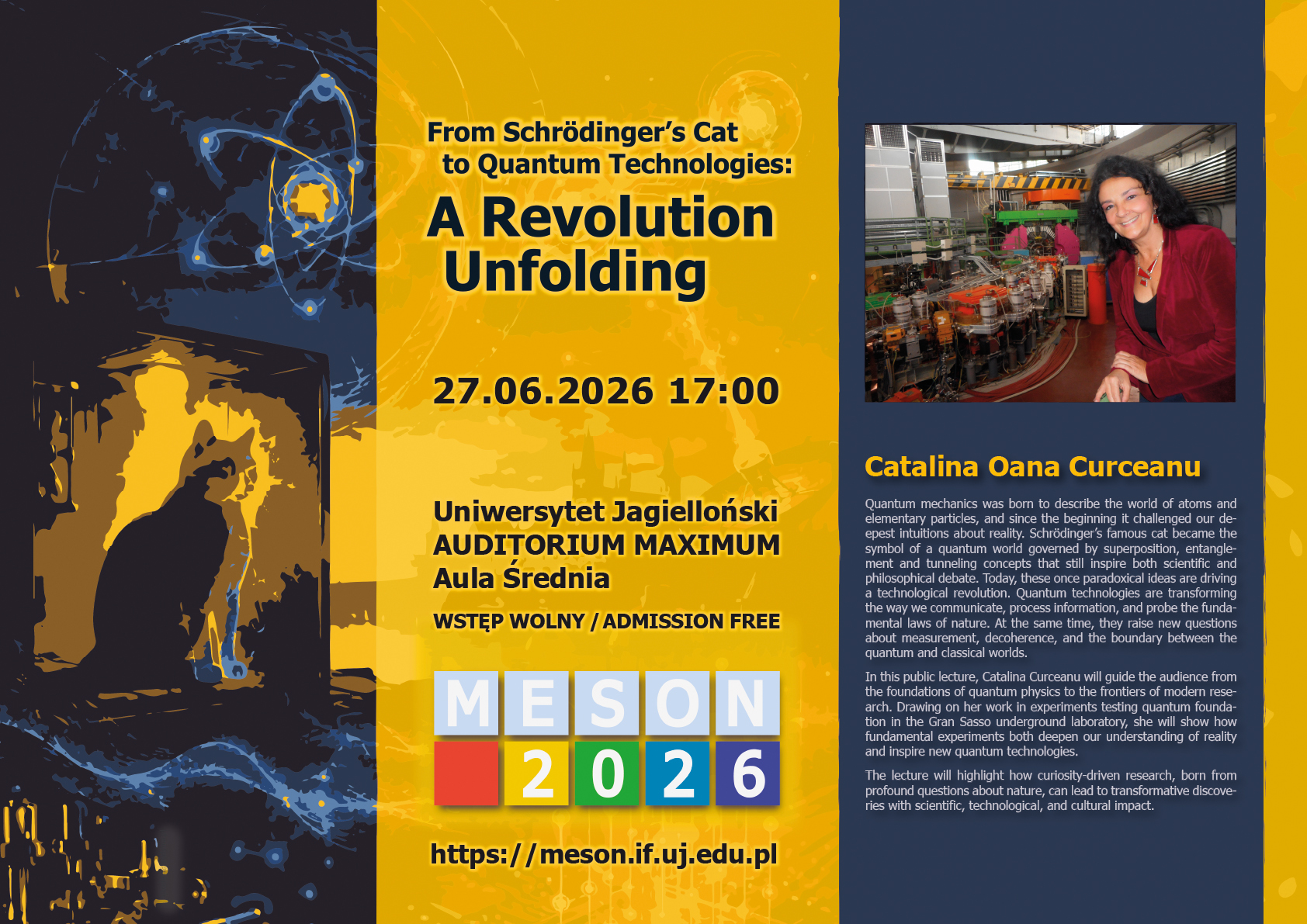
Speaker
Description
High-energy nuclear collisions provide important information on the characteristics of strongly interacting matter at extreme temperatures and densities. Among the most used experimental observables that provides valuable insight into the system dynamics and the kinetic freeze-out stage are the transverse momentum spectra of the produced particles. We present a study of the mean transverse momentum <pT> of identified strange hadrons ($K^{0}_{S}$, $\Lambda$, $\bar{\Lambda}$, $\Xi^{−}$, $\bar{\Xi^{+}}$, $\phi$, $\Omega^{-}$,$\bar{\Omega^{+}}$) produced in Au+Au collisions at RHIC-BES energies (7.7-39 GeV). Its dependence on the collision energy and centrality will be presented. The power-law exponent, $\alpha$, of the $N_{part}$ dependence decreases with energy indicating the shift from baryon-dominated hadronic matter to a regime where partonic degrees of freedom and non-equilibrium dynamics become important. The mass dependence of the $\alpha$ parameter can indicate a competition between the mass-dependent hydrodynamics and flavor-dependent decoupling during the fireball's expansion.